9.24.2006

Run, little Amish girl, run!

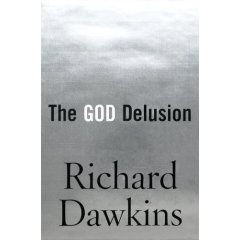
Mark the day, October 18, 2006: Ginny’s going to meet Richard Dawkins! (err, listen to him give a public lecture.) As I’ve said many times on this blog, I love the man and his clever, lucid writing. If you’re in the market for a good read, pick up his new book, The God Delusion, which is now ranked #9 on amazon.com’s bestseller list.

Fair warning: As a large book, it can be a bit awkward trying to hide the cover jacket from nosy (and potentially pious) seat neighbors on the subway…but then again, the book jacket is orange and metallic silver, so the casual observer might just mistake it for Michael Crichton.

Here are a few of my favorite quotes…for the first, I actually laughed out loud.

On the Amish (after explaining why respecting religious “diversity” is a load of crap):

“The rest of us are happy with our cars and computers, our vaccines and antibiotics. But you quaint little people with your bonnets and breeches, your horse buggies*, your archaic dialect and your earth-closet privies, you enrich our lives. Of course you must be allowed to trap your children with you in your seventeenth-century time warp, otherwise something irretrievable would be lost to us: a part of the wonderful diversity of human culture. A small part of me can see something in this. But the larger part is made to feel very queasy indeed.”

(*I had initially planned to write my thesis on the non-electric, and thus “green” agricultural technologies used by the Pennsylvania Amish. However, after spending a few days at the library reading about their faith and seriously deranged customs, I was creeped out enough out to drop the Plain People.)

On religion’s role in the war in Iraq:

“Our Western politicians avoid mentioning the R word (religion), and instead characterize their battle as a war against ‘terror’, as though terror were a kind of spirit or force, with a will and a mind of its own. Or they characterize terrorists as motivated by pure ‘evil’. But they are not motivated by evil...They are not psychotic; they are religious idealists who, by their own lights, are rational. They perceive their acts to be good, not because of some warped personal idiosyncrasy, and not because they have been possessed by Satan, but because they have been brought up, from the cradle, to have total and unquestioning faith.”

9.21.2006

Quiz: What City Fits You Best?

Just took this city quiz...and after my wonderful few days in Chicago, I think it may be right-on...

American Cities That Best Fit You::
70% Chicago
65% New York City
65% Philadelphia
60% Boston
60% Washington, DC

Why a Pale Blue Dot?

I just spent the last few days in a breathtakingly beautiful Chicago for the Pale Blue Dot III astrobiology conference. I met some brilliant astrobiologists and astrobiology graduate students, who manage to stay motivated and enthusiastic despite NASA’s significant cuts in the field. And they taught me SO much—about the Earth’s climate, the clouds of Venus, the rocks of Mars, the machines that can determine a distant planet’s surface chemistry by looking at just a speck of light, even the odds of getting hit by an asteroid.

But of all the tidbits I didn’t know Saturday and do know now, here’s the one I was most embarrassed not to know (and thought my faithful blog readers would most enjoy):

When viewed from space, the Earth looks like—to quote Sagan—a “pale blue dot,” not because of our vast oceans. No, the astrobiologts patiently explained, the oceans are actually very dark. We look blue for the same reason the sky looks blue when standing on earth: because the oxygen and nitrogen molecules that make up our atmosphere absorb short wavelengths—blue!—and not longer wavelengths like red. It actually gets a lot more complicated, of course, with details about cloud cover, but I'm pretty sure that was the jist.

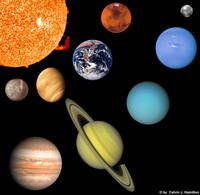
The photo here shows the Earth and its moon as seen from cameras on Mars.

9.13.2006

Unbounded Admiration

I just got my hands on Richard Dawkins’s new book, The God Delusion. As my students from last year can attest, I’m a Dawkins fanatic, and am deeply engrossed in his new tome. Not sure if Dawkins is just less cautious now in his elder years, but this book certainly has a tone more...hostile than the others. Pretty amusing so far, though.

Anyway, I found one of the book’s early passages—a quote from Einstein—quite surprising. Dawkins reminds us of Einstein’s most quoted remarks about the existence of God (like “Science without religion is lame, religion without science is blind"), and then hits us with this rarely-quoted doozie from Al:

“It was, of course, a lie what you read about my religious convictions, a lie which is being systematically repeated. I do not believe in a personal God any I have never denied this but have expressed it clearly. If something is in me which can be called religious then it is the unbounded admiration for the structure of the world so far as our science can reveal it.”

...So much for “God doesn’t play dice with the universe,” right?

9.12.2006

From the Annals of Human Behavior Trivia

From Nature News:

“Psychologists have long known that unwritten rules govern our social interactions. Some researchers have found that women stand closer together than men when talking, for example. Men are also less likely to maintain eye contact. And both sexes will reduce eye contact if the person they are talking to gets too close.”

Read the full story, about keeping your “personal space” in virtual reality.

9.08.2006

Coma, Schmoma

Creepy news of the week: doctors hooked up brain scanners to a vegetative woman, talked to her, and found out her brain responded exactly as if she were conscious. And this of course immediately reminded me of a season 6 Sopranos episode where Tony comes out of his coma thanks to the sincere pleadings of Meadow….. “Don’t go daddy, we love you. Don’t goooooooo”

Check out all the gory details about the real news on Culture Dish, the fabulous blog of science writer Rebecca Skloot.

9.07.2006

Extrasolar Waterworlds

I started my new internship at Seed on Tuesday, and got my first Seed clip at 5:27 p.m. today. Habitable worlds, according to a paper that will be released in tomorrow's Science, might just be spinning in solar systems we already knew about, and more exciting--they're probably covered in global oceans.

Read my full story here.

UPDATE: a one-sentence review of my article, from Knight Science Journalism Tracker. hehe

9.02.2006

Top 100 Wikipedia Pages...

Since Wikipedia has so quickly become ingrained in our American culture (with recent feature articles about its creation and evolution in Nature, the New Yorker and the Atlantic), one would think that the list of the 100 most popular Wikipedia pages would reflect those topics that are most important to us. Here's a sampling...

#4: List of Big-Bust Models and Performers
#5: JonBenet Ramsey
#6: List of Sex Positions
#11: Irukandji Jellyfish (what the....?)
#14: World Wrestling Entertainment Roster
#98: Criticism of Family Guy

Time, Un-metered

Once upon a time there was a this, then there was a that, and finally, the end. In today’s Western world, this is how most stories are told. Children’s fables, blockbuster action movies, and even pop songs follow a linear, predictable chronology. And the everyday physical surroundings in our flat, paced, rated, labeled, bounded world are equally predictable. City planners arrange streets in rectangular grids; stoplights turn on, off, on, at timed intervals, to tame the flow of traffic; taxis charge by the mile; buildings are labeled with numbers, and jut from their foundations at 90-degree angles.

James Rouvelle, an artist and technology specialist at the Maryland Institute College of Art, says this metered world affects the way we live, manipulates us, in fact, to behave in a predictable way. “We are wired to scan our environment and adapt to whatever we discover,” he explains, “in other words, we train to the medium.” So we navigate those orderly streets, stop and go when we’re supposed to, wear watches on our wrists. “Our time is monochromic,” he says, “everything is ordered and dictated by a watch.”

And for Rouvelle, this metered sense of time is worrisome. “My concern,” he says, “is that we—Western culture—have, over the past few hundred years, chosen to develop along a trajectory of reductionism, trying to understand things by breaking them down into individuated, component parts whose behaviors are often described as relating to other unique components sequentially, and verified metrically – and often visualized.”

The visual description of time, at least in Western classical art, is often a sequential one. In many of the great Piero Della Francesca's pieces (like The Queen of Sheba's Visit to Jerusalem, above), for instance, the progression of the action is achieved by the viewer looking from left to right. First, then, finally—story told.

But many contemporary artists and architects are looking to break free of this metered perception of time. Rouvelle encourages this change, as he believes an un-metered temporal perspective can enhance both our aesthetic and social experiences. “There are complementary experiences, non-linear experiences,” he says, “where time, for example, is not moving in a specific direction, yet change is evident. I believe that these non-sequential experiences are equally real, however, and that if I could contemplate them more fully my experience overall would be significantly different.” And artists, he says, have the means to create less metered descriptions of the world, and thus make the world a better place. “I believe that if we could improve our understanding of our experience through better and more accurate models,” he argues, “we would experience greater empathy with others.”

Here are a few examples of recent art and architecture that flaunt a non-linear expression of time, and in this way, force their audiences to experience time un-metered…

The Site of Reversible Destiny

On the other side of the world, in Japan’s Gifu Prefecture, two New York artists created an external environment completely unlike the ordered grid in the Big Apple: The Site of Reversible Destiny. In October 1995, architect Shusaku Arakawa and his creative partner, poet Madeline Gins opened this “experience park” of lushly vegetated mounds, inclined planes and maze-like interiors to offer visitors, as the website states, “opportunities to rethink their physical and spiritual orientation to the world.”

If you look at a map of the park, the names of the featured sites sound like some kind of metaphysical Disneyland: the Gate of Non-Dying, the Exactitude Ridge, the Zone of the Clearest Confusion, the Kinesthetic Pass, and even the Destiny House. Then there’s the Critical Resemblance House, which has a labyrinth of hallways with furniture arranged on the floor, under the floor, and on the ceiling. Outside the buildings, scattered throughout the green outdoor landscape, are 24 species of medicinal herbs “that give it a gradually changing complexion from season to season.”

The park also—like Disney’s rollercoasters—disturbs balance; a warning on their homepage, written in red text, reads: “Because the Site of Reversible Destiny-Yoro Park has many steep slopes, we advise that you wear rubber-heeled shoes.” Indeed, since the park opened in 1995, Rouvelle says it has had to set aside funding specifically for medical bills of the dozens of visitors who, just from walking around the disorienting landscape, have fractured or broken bones.

Clearly then, the Site of Reversible Destiny creates an endlessness that we don’t normally experience. Psychologist and art critic Rudolf Arnheim argues that this endlessness, especially when experienced outdoors, grants art and architecture “a high aesthetic value.”

Rouvelle would agree. He says the Site of Reversible Destiny—without flat surfaces, street grids, or 90-degree angles—“forces us to come to terms with physical angles that are becoming less and less common” in Western city life; in other words, it’s exactly the kind of art that can help us break free of a metered sense of time.

Expérience de la Durée, Biennale de Lyon 2005

“Experiencing Duration” was the theme of the 2005 Lyon Biennale, a contemporary art show with venues in Glasgow, Frankfurt, Paris, Milan and Vilnius. The show’s curators, Nicolas Bourriaud and Jérôme Sans, wrote they hoped the hundreds of paintings, film, video, light, and sound installations would “eschew the current temptation of a return to the traditional categories of painting and sculpture and video. We wanted to stress the fact that art is an experience that engages the spectator.”

Echoing the words of James Rouvelle, Bourriaud and Sans explained on the exhibition’s website why time is such a provocative theme to explore in art: “Addressing time was a way for us to draw up an inventory of the 1990s, when art began to function as a sort of editing bay on which artists could reconstruct everyday reality.” These artists, the curators explained, “tweaked the tempo” of their art—displaying videos and sounds that had been paused, looped, or synchronized in unexpected ways. “Time is more a building material than a mere medium,” Bourriaud and Sans argued. More than a static oil painting or stone monument, they wrote, “art is first and foremost an event.”

RIPLTRANE

Both the Site of Reversible Destiny and the exhibits at the Lyon Biennial use art to manipulate the viewer’s experience of time. But other forms of contemporary art—like interactive sound projects—are themselves manipulated by time. One such dynamic project, designed by Rouvelle and Berlin-based artists Innes Yates and Judith Bieseler, is called Research, Instructions, Programs, and Logic for Trans-Robotic Adaptive Networked Environments, or RIPLTRANE. Launched in March 2004 and still going today, RIPLTRANE allows participants in both New York and Berlin to step or dance on pressure sensors in a tiled floor. Their stepping patterns go through a computer, which then creates accompanying sound and lighting effects and relays the patterns, through the internet, back and forth between both cities. In this way, the art is manipulated by the participants themselves (and the time lag between the transatlantic transmissions). As Rouvelle writes about the project on his website, RIPLTRANE is an experiment of layering a physical environment “with information and events occurring locally and at distant geographic and temporal locations…Our intention is to start something that will take on a life of its own.”

Remove Your Watches!

Changing our experience of time—that is, un-metering it—is not an easy task. It may be worth the psychological (and in the case of the Site of Reversible Destiny, physical) effort for an artist who wants to create and appreciate art in new ways. “Artists can definitely contribute to the creation of better models [of time],” Rouvelle says. “The content of our models and their presence in our common spaces is an aspect of our collective development. We must, I think, take the role of objects and their affect seriously as we build our world.”

But even those uninterested in art, Rouvelle continues, should make the attempt. Experiencing un-metered time, he says, will help our interpersonal relationships, help us to better empathize with others. He argues that, “the general public can benefit by having aspects of their lives made more available for their own consideration via aesthetic creations that explore the complementary senses and experiences of non-linearity.”

To Rouvelle, all of human development, in fact, is about the way we choose to perceive and influence time. “If we want to develop along a different trajectory we must take action and do so. We have a responsibility to do so.”

8.24.2006

UPDATE: Pluto is NOT a planet!!

So the big dogs met today, and surprise—Pluto is NOT a planet after all! Aw, poor thing. (Read the full story from the Washington Post)

8.18.2006

''Yes, Virginia, Pluto is a planet.''

Next week in Prague, a group of astronomers are planning to tell the International Astronomical Union--the body that decides, officially, what is or is not a planet--that there are not nine planets, but 12.
(Read the full story.) Here's what a few Johns Hopkins astronomers had to say about the whole affair (p.s.--dontcha just love nerdspeak?)

Richard Conn Henry, physics and astronomy professor:
"I think the notion that Pluto is a planet is absurd. When it was initially discovered,it was thought to be vastly more massive than it turned out to be. Its orbit is radically different from that of all the other planets. Down with Pluto, is what I say!"

Karl Glazebrook, physics and astronomy professor:
"...if I were in charge, I would insist on a diameter of greater than 1,000 kilometers to define a 'planet' in order to remove Ceres from the list. But that would be an arbitrary cut to preserve the order of the main nine and to save the hassle of rewriting textbooks...Definitions and naming really matter little physically, anyway."

William P. Blair, research professor in the Department of Physics and Astronomy and chief of observatory operations for NASA's Far Ultraviolet Spectroscopic Explorer Satellite:
"This is really not a burning issue for most astronomers. It really is a 'classification' problem more than an issue of science...From what I can tell, they have tried to come up with a consistent definition: an object roughly spherical under its own gravity, orbiting a star, and not orbiting something else. OK, so far. Then they are apparently willing to immediately bend this relatively simple definition and allow Charon to itself be called a planet, with Pluto and Charon being a 'double planet' system. This goes too far and seems inconsistent to me."

Harold A. Weaver Jr., project scientist at Applied Physics Laboratory:
"...we must not forget that any attempts by us to pigeonhole objects in the universe are bound to have shortcomings. The classification schemes that we invent help us to place diverse objects in context, but we must also recognize that nature often doesn't adhere to our attempts to categorize things...In any case, I doubt that the IAU could come up with a resolution that would please everyone."

Andy Cheng, Applied Physics Laboratory:
"...the new definition of planet does not work for me, because 'hydrostatic equilibrium' is an idealization -- it is approximately correct for planets like Earth but is not exact. There is still no criterion for deciding how far from hydrostatic equilibrium an object can be and still qualify as a planet."

8.17.2006

The latest in looking for life on the Red Planet

It's been three months since I finished my thesis on the hunt for life on Mars. Here's a great lil story I picked up on digg about what's next on the horizon...but I'll betcha those sturdy rovers will still be kickin' around up there when the Lander arrives... "The launch of the Mars Phoenix Lander is just a year away. The spacecraft will be aiming for the martian north pole, and if it lands successfully it will dig in snow and ice in one of the few places on Mars where scientists think life could be preserved." read more | digg story

8.16.2006

Have we all gone nano-crazy?

Seems like every product in the CVS aisle is trying to jump on the nanotechnology bandwagon. And thanks to a website created by the nonprofit group Project on Emerging Nanotechnologies earlier this year, anyone with a computer can browse the 200+ nano-products now commercially available. (The list includes, among the somewhat mundane face creams and household cleaners, the more surprising odor-eating shoe inserts, foam neck-support pillows, and even chocolate-flavored bubble gum.)

Here are a few of my favorite products, along with the hype they tout on their websites about those teeeeny tiny nano-ingredients (in no particular order):

Fullerene C-60 Day and Night Cream
Zelens, UK

“Fullerene C60 is a naturally occurring microscopic form of carbon, of the same purity as a diamond, which was found to have remarkable anti-oxidant properties. The key to the power of Fullerenes C60 lies in its shape. Its 60 carbon atoms are arranges like a soccer ball, with 32 surfaces. Each of these surfaces attract, and neutralise, the damaging free radicals, leading scientists to call Fullerene C60 the ‘radical scavenger.’”
(http://www.zelens.com/)


Rénergie Microlift
Lancome, France

“Microlifters are made of nano-particles of silica and proteins form a network to immediately lift and tighten skin.”
(http://www.lancome-usa.com/_us/_en/skincare/animations/renergiemicrolift/ discover.aspx?CategoryCode=AXESkincare&&&&)


Nanosilver Antibacterial and Deodorant Insole
Goodweave textiles Co. Ltd., Taiwan

(NB: for this one, I only wonder how much hype was lost in translation…)
“Nanosilver textile fiber has the ultra strong bacteriacidal power. Sterilization rate reaches as high as 99.99%. It may deodorize, stop itching and effectively prevents the athletic foot blood circulation, a moisture absorption and release of perspiration. The high permeable material quality, it can often guarantee the foot dry and neat.”
(http://www.goodweaver.com/)


Nanoceuticals Slim Shake Chocolate
RBC Life Sciences, USA

“NanoCeuticals™, with nanoscale ingredients, allow RBC to create products that:
-Scavenge more free radicals
-Stimulate the source of energy
-Increase hydration
-Balance the body’s pH
-Reduce lactic acid during exercise
-Reduce the surface tension of foods and supplements to increase wetness and absorption of nutrients
(http://813312.royalbodycare.com/Nanotechnology_Revolution.aspx)


Contour-Foam Silver Neck-Support Pillow
Sharper Image, USA

“Ultra-fine silver particles are infused throughout Sharper Image's exclusive space-age Contour-Foam Silver products. Created by advanced nanotechnology ("nano" indicating one billionth), these silver nanoparticles average only about 25nm (nanometers) in diameter — one 200 thousandth of a human hair — invisible to the eye but adding immeasurably to you well-being by making this pressure-free, comforting part of your home environment cleaner, fresher and healthier.”
(http://www.sharperimage.com/us/en/catalog/productview/sku__ZN004)


Nanover Hair Care
GNS Nanogist, Korea
“NANOVERTM Shampoo using nanosilver technology, ingredients go into hair quickly and deeply, has outstanding moisturizing and dandruff removing effect.”
(http://www.gnsnanogist.com)

NDMX Golf Balls
Nanodynamics, Inc., USA
“The much-anticipated launch of the revolutionary ball based on patented NDMX™ hollow metal core technology is ready for fairways and greens worldwide. Not only that, NanoDynamics™ has added a nano-enhanced polymer companion ball, the NDLiNX™, to its offering!”

(http://www.nanodynamics.com/Home/webstore)

8.15.2006

Secret Sharing...

My West Wing wife, crossword puzzle partner, and deepest-secret sharer just moved to California. For five years. So I’m feeling so blue. But! There’s always writing….and Ben & Jerry’s. And! I’ve just discovered a website that made me smile: Share Your Secret. In case you don’t live in NYC and haven’t seen the site’s HUGE metro advertisements, Share Your Secret is a place where anyone can anonymously post any secret (sponsored, of course, by Secret deodorant).  Below are a few goodies…

“I want to keep having babies so I don’t have to go back to work.”

“I am addicted to peanut M&Ms.”

“I want to get over him, but I can’t.”

“I sleep with a teddy bear.”

“Sometimes I pretend I am a cook on a T.V. show in my kitchen.”

“I talk to myself.”


8.10.2006

Plan B: Pros and Cons

In 2003, medical advisors at the FDA declared that Plan B--Barr Pharmaceuticals' morning after pill--was safe and effective enough to sell over the counter, to women of any age.

Three years pass.

This Tuesday the FDA met with Barr and finally decided to make the drug available to women 18 or older. It could be on pharmacy shelves in a matter of weeks.

But not everyone thinks this is such a good idea...pro-lifers, overprotective parents, and The Onion have all formed strong objections. Read The Onion's piece if you're in the mood to laugh.

7.27.2006

Wirehaired Bugs

A study released last week reveals that many kinds of bacteria sometimes grow minuscule protein-and-iron wires that conduct electricity. The researchers say the wired microbes "will give us insights into all of microbiology that we can't even dream of yet," potentially allowing us to build more-efficient biological fuel cells and understand an important dynamic in the life of bacteria.


...read the rest of my article on Discover's website: http://discover.com/web-exclusives/nanowiredbacteria/

7.18.2006

It's Deathly Hot...

...in the city this week. I can't go outside without melting. A new study shows that summertime heat claims more lives than all other weather-related disasters combined, including tornadoes and hurricanes.

from the press release:

“Heat is a stealth killer,” says Dr. Scott Sheridan, Kent State associate professor in geography. Funded by the Environmental Protection Agency, Sheridan recently finished conducting a study on how effectively heat warning systems have been implemented in four cities for which he developed heat warning systems, including Dayton, Ohio, Philadelphia, Phoenix, and Toronto, Ontario.

Sheridan surveyed residents 65 and older in each of the four regions about their perception of heat vulnerability, their knowledge of options for dealing with the weather, and why they did or did not take action to avoid negative health outcomes during the heat emergency.

He found that almost 90 percent were aware a heat warning was issued, but only about half of the people did anything about it. Many thought messages were targeting the elderly and did not view themselves as part of that group. For those who did change their behavior on hot days, it was not necessarily due to heat warnings issued by weather forecasters but instead based on their own perceptions of heat.

7.13.2006

Bugs sprouting tiny, tiny wires

When Yuri Gorby discovered that a microbe that makes toxic metals safe can sprout tiny electrically-conductive wires from its cell membrane, he reasoned this anatomical oddity and its metal-changing physiology must be related. Bacteria will, under particular environmental conditions sprout nanowires that can shuttle electricity to other cells.

read more | digg story

6.30.2006

oooo that stings...

Scorpion venom--of all things!--may be the key to treating brain cancer.

discover.com/web-exclusives/scorpion/

6.29.2006

62-year-old Science Teacher Fights Back Against ID

...Babs Greene, another administrator, "asked if I was almost finished teaching evolution," Ms. New recalled. "I explained to her again that it is a unifying concept in life science. It is in every unit I teach. There was a big sigh."...
In a country where 50-odd-percent of citizens don't believe we descended from apes, it's heartening to see that a mild-mannered middle school science teacher can stand up to the religious convictions of the administrators in her Georgia public school district. Read the New York Times story about the courageous Ms. Pat New at: http://www.nytimes.com/2006/06/28/education/28education.html?ex=1152158400&en=15100578c104079f&ei=5070&emc=eta1

6.27.2006

New neurons may not make you smarter...

Check out da latest Discover clip: http://www.discover.com/web-exclusives/newneurons/

6.24.2006

God for rich people

I hadn’t realized religious fundamentalism had caught on with NYC yuppies, until this morning, when I read the mini-sermon printed on my Starbucks cup:

“The Way I See It #92”

You are not an accident. Your parents may not have planned you, but God did. He wanted you alive and created you for a purpose. You were made by God and for God, and until you understand that, life will never make sense. Only in God do we discover our origin, our identity, our meaning, our purpose, our significance, and our destiny. –Dr. Rick Warren, author of The Purpose-Driven Life

6.18.2006

Can we trick our taste buds?


new clip from FirstScience:

http: //www.first science.com SITE/ARTICLES/taste.asp

6.17.2006

read about Frank the poet...


...in the June issue of Johns Hopkins Magazine:

http://www.jhu.edu/~jhumag/0606web/poetry.html

6.08.2006

Helllllo NYC!


All moved into the most fabulous city in the country--NYC! I'm working as an intern at Discover Magazine, and here is my very first clip!

http://discover.com/ web-exclusives/drowsophila/

4.26.2006

Whee!

Thesis is done! Printed. Bound. On the shelf. ...bye bye Baltimore

4.19.2006

How to Make a Life-Detector

“To some people it may seem that the very strangeness of Martian life precludes for it an appeal to human interest. To me this is but a near-sighted view. The less the life there proves a counterpart of our earthly state of things, the more it fires fancy and piques inquiry as to what it be.” Percival Lowell, Mars and Its Canals

On a Thursday afternoon in early February, in a residential neighborhood of Chevy Chase Heights, the dingy-brown building of Carnegie Institution’s Geophysical Laboratory looms from the top of a steep and grassy hill. At the bottom of the hill is a wooden entrance sign, just 20 feet from a pile of logs and tree stumps. On one branch of one naked magnolia a gray hooded sweatshirt hangs forgotten. The grass of the grassy hill is dead, and crunches when you trudge through it. The lab houses one hundred and fifty of the nation’s best scientists, but only a handful of cars are parked along the edge of the driveway that winds up sharply to the front door. When the elderly secretary enters the door’s security code, you can hear the slow punch of the buttons, and the soft shuffle of her shoes on polished linoleum as she escorts you down the empty corridor.  In short, it’s everything you might expect from a Martian-life-detection lab.

In 1996, NASA triumphantly announced the find of ALH84001, the meteorite that supposedly harbored fossils of ancient Martian life. Andrew Steele was the young Brit who showed, just months after the announcement, that meteorite ALH84001 was contaminated with Antarctic bugs. But even after undercutting NASA’s triumphant find, Steele still believed we might one day find life on the Red Planet. In the last decade, with the help of groups who study the biological workings of extremophiles on Earth, many astrobiologists and astronomers have tried various approaches to the hunting of life beyond Earth’s orbit. Steele’s group, focused on making life-detection instruments for both rover and manned missions to Mars, finds a home in a few of the microbiology labs in the creepy building on the hill.

Though a decade has passed since he trumped NASA’s claim, Steele still looks like a grungy twenty-something. He’s tall, lean, and slightly apish. His wavy blonde hair covers the letters printed on the back of his t-shirt, so you can’t quite read the name of the garage band that’s printed on it; his blue jeans are so faded they’re white. He’s dirty, but wears jewelry—rainbow bracelets on his wrist and a heavy Celtic cross around his neck. He walks lightly on old green sneakers, the same ones he had in August, when he traveled to the other side of the world to test his gadgets.  

In August of 2003, 2004, and 2005, Steele and his colleagues went to the Arctic Circle island of Svalbard. Svalbard is not only cold—dropping down to -12 degrees Celsius (10 degrees Fahrenheit), even in August’s 24 hours of daylight—but dusty, and dangerous. (Steele’s crew, armed with shotguns, had to switch between crushing up rock and watching for polar bears.) The island is the only place on Earth with a volcano that has the kind of rock that was sampled on the Viking missions. And most important, the rock harbors microorganisms that Steele’s gadgets can try to detect.

The gadgets are called microarrays, matchbook-sized glass chips coated with different kinds of antibodies. Each antibody recognizes in a rock different life-specific molecules—like nucleotides (the building blocks of DNA), amino acids, proteins, or certain carbon isotopes—and when it finds them, it glows. Steele says the chips will be used on NASA’s next big rover project, the 2009 Mars Science Laboratory (MSL). The MSL, part of NASA’s larger Mars Exploration Program, plans to send a nuclear-powered rover to Mars, much larger than the golf-cart sized Spirit and Opportunity rovers that are up there now. In their two years of exploring, Spirit and Opportunity have each traveled about three miles. By comparison, the MSL is a tank; it will travel up to 90 miles per hour, roll over obstacles 30 inches high, and will have a full on-board laboratory for testing climate changes and geological samples.

But to gain a true understanding of the landscape and really probe for life, Steele says, rovers aren’t enough; you need men. “Rovers are pretty easy now, we could send rovers all over the place for about $900 million a shot,” he says. “But a human being is a thousand times more capable than any robot.” Rovers have to stay on a horizontal plane, for instance, so they often don’t have the right visual perspective to find subtle-yet-important geological features, like bedrock. Also, their controllers on Earth can’t manipulate the machines in real time; they’re eight minutes behind. But the biggest problem, according to Steele, is that a rover doesn’t have object recognition. “An elephant could run in front of it,” he says, “and it wouldn’t know the difference.”

To make his point, Steele cites one rover story NASA hasn’t released. A few months ago, a wire broke on Spirit’s arm.  “So the engineering team spent a few days fixing it, slowly working the arm to loosen the dust they thought got into the motors,” he explains. Since Spirit was immobile for a few days, the scientist team decided to take high-resolution photographs of the landscape, instead of the usual low-resolution ones. And the result was amazing: Steele says the new photos gave them an incredible view of the surrounding geological features, including those that might indicate an ancient flow of liquid water.  As he explains: “They said, ‘oh my god, those crossbeds are fantastic. This is just brilliant,’ but normally, the rovers would never have caught all of that detail. A human would have seen it right away.” And the detail, in this case, was crucial: “it was evidence,” Steele says, “of water-induced features in the rocks.”

In addition to tweaking the rover machines, Steele’s also working on what he calls the next generation of gadgets: those that would allow planet exploration by astronauts.  “We’re making computing technology, like GPS and camera systems, and a barcode system that automatically labels samples,” he explains. This would have been nice for the astronauts of the Apollo missions because, as Steele says “the geezers don’t have time to get everything—on the Moon they often forgot to record locations and label properly.” But with the new toys, he says, “the astronaut merely needs to bag it, tag it, and the rest is done.”

This emphasis on creating technology for astronauts spurs Steele to visit extreme environments like Svalbard over and over again. He plans to go back for the next three Augusts, until the MSL is launched.  “It’s good for the scientists to think they’re on Mars,” he says, “because you think: where is my next meal coming from? It makes you realize you have to make the science as easy as possible for the astronauts, because they’ve got to concentrate on staying alive.”


Detecting “Habitable” Worlds

Iain Neill Reid is an astronomer at NASA’s Space Telescope Science Institute in Baltimore, the birthplace of the Hubble Telescope.  Though Reid had been using the Hubble to study dwarf stars for many years, in 2003, he switched gears.  “A few of us here just started looking at how we could work in astrobiology,” he says, “partly because the emphasis was switching at NASA, but also because at that time there was a lot of effort going into thinking about the Terrestrial Planet Finder.”

The Terrestrial Planet Finder (TPF), a telescope project conceived by the brains at NASA’s Jet Propulsion Laboratory, is new, and hasn’t been built yet. It was only in 1995, after all, that astronomers used high-powered telescopes to discover that solar systems besides our own even exist. Since then, astronomers have found over 100 planets orbiting other stars. But the TPF won’t look for just for any old planet. Its job is to look for habitable planets like Earth. A planet like the Earth, Reid says, is about 100 million times fainter than its star. So to make a planet visible, you need to use telescopes (very elaborate, expensive telescopes) that block the light from the star. And once an astronomer can see clearly the planet in question, Reid says, “we could tell the microbiologists ‘here’s what the conditions might be like,’ and then, they could tell us what could live there.”  

In 2003, Reid joined Frank Robb and a few other extremophile experts at the Center of Marine Biotechnology and submitted a proposal to the NASA Astrobiology Institute (NAI). He says they wanted to “ask if there are particular places in the galaxy that are more favored to life than others.” But the NAI Committee at the time, Reid recalls, said the project—searching the entire universe for Earth-like planets—was too ambitious. So for the next couple of years, Reid’s group funded what they could themselves. “We had a small amount of research money here at Space Telescope, only like 50 or 60K,” Reid says, “but it was enough to pay for a grad student and get equipment.” The shoestring operation became the basis of a new, scaled-back NAI proposal the team submitted in October of last year, where they suggested to look only at stars within 25 parsecs of our Sun.

While Reid and his team were searching for planets, others were looking for stars—stars that would be best suited to host a planet with intelligent life. Though intelligent alien life has long been the stuff of popular science fiction, a large group of scientists, involved in a project called the Search for ExtraTerrestrial Intelligence (SETI), is seriously hunting for real ETs beyond our solar system. This February in St. Louis, a panel of astrobiologists from SETI and elsewhere held a press conference at the meeting of the American Association of the Advancement of Science (AAAS). The panel explained how to go about looking for intelligent life—that is, how to send messages to beings that could, in turn, send messages back to us.

The task is a big one: 100 billion galaxies are thought to exist, each with 100 billion stars—a gazillion places that could potentially receive and acknowledge our messages. Astronomer Maggie Turnbull of the Carnegie Institute is starting to narrow down the astronomical list. As she announced at AAAS, Turnbull has identified a mere 19,000 stars whose solar systems might provide a “habitable zone”, and of these, has made a top-five list from which to begin searches.

“When I was given the charge of making the target list for SETI,” Turnbull explained to National Public Radio, “I asked myself, just what is it about the Sun that makes it a good parent to life forms on Earth?” Most important, she said, is stability—she sought stars that didn’t change their level of brightness too “quickly” (sometimes quickly meant billions of years) for life to evolved on their surrounding planets. This requirement ruled out all of the massive stars in the galaxy, because they don’t live long enough. Because SETI is interested in intelligent life, Turnbull’s second requirement for a good “star parent” was a practical one: “Close stars are better than further stars,” she explained, because we wouldn’t be able to send radio signals to stars too far away. These eliminations brought the list down to 19,000. “Obviously 19,000 is quite a lot of stars and it will take quite a long time to go through all of those,” Turnbull explained. So she then arbitrarily whittled 19,000 to five, “for the purposes of communicating it to the public.”

With the star list thus narrowed, SETI has set up the Allen Telescope Array (named for and mostly funded by billionaire Paul Allen, co-founder of Microsoft), a cluster of 350 radio antennas in northern California. The antenna network, which should be built by 2008, is designed to “listen” for radio transmissions sent from intelligent civilizations in the solar systems of Turnbull’s chosen stars. Jill Tartar, head of the SETI Institute, says that old systems were able to scan about 1,000 stars in a decade; in the next ten years, the Allen Array will scan at least a million.

These searches are based on finding life as we know it—i.e., self-sustaining chemical systems that undergo evolution at the molecular level. But some scientists and philosophers think this is the wrong approach. “What we really need to do is to search for physical systems that challenge our current concept of life,” says Carol Cleland, a philosophy professor and fellow at the NASA-funded CU-Boulder Center for Astrobiology, “systems that both resemble familiar life and differ from it in provocative ways.” Cleland says looking for life different from ours may not be as difficult as one might think. Life on Earth works using only about 20 basic proteins (called amino acids), even though nature provides more than 100. This means that, as Cleland argues in the January 16 issue of the International Journal of Astrobiology, an “alternative microbial life” could exist on Earth, and therefore, could also exist on other planets.

Cleland says the latest life-detection instruments, based on our current definition of life, limit our ability to find life on other planets. “If the DNA in an alien organism was even slightly different than the DNA in life on Earth,” she says, “we probably wouldn’t be able to recognize it. Instead of looking for life as we know it, scientists may be better served to look for anomalies, which amounts to looking for life as we don’t know it.”

NASA Pulls the Plug

No matter what kind of life they’re looking for, all of these scientist-hunters recognize that some of the biggest mysteries are found right here on Earth.  Steele says of finding Martian life: “If we find it—fantastic! Brilliant! Superb! Let’s go get it, let’s study the hell out of it, let’s classify it. But actually, I’d be more interested if we don’t find life on Mars, and then why there isn’t life there. What went wrong? Why is Earth special? For me, that’s the biggest reason for going.”

On January 14, 2004, following reports of the success of Spirit and Opportunity, President Bush made a speech outlining his new “Vision for Space Exploration.” Reminiscent of Kennedy’s 10-year Moon challenge in 1960, Bush proclaimed that rovers were necessary, at first, to serve as “trailblazers,” and “the advance guard to the unknown.” But ultimately, he said, we need to go the next step: “The human thirst for knowledge ultimately cannot be satisfied by even the most vivid pictures or the most detailed measurements. We need to see and examine and touch for ourselves.” Bush’s exact plan called for the development of a new spacecraft, called the Crew Exploration Vehicle, which would fly by 2014, carry men to the Moon no later than 2020, and then eventually, carry them to Mars.  Bush said the main purpose of the Crew project is to take astronauts beyond our orbit, “to other worlds.”

All of this life-detection work—Steele’s life-detection chips, Reid’s TPF telescopes, Turnbull’s Earthshine—began, and continues, on the promise of financial support from Uncle Sam. But this February, two years after announcing his new vision, the President’s budget didn’t give NASA as much money as it was hoping for, causing NASA head Michael Griffin to funnel money into manned space flight and out of astrobiology. Consequently, all three of these life-detection projects have been put on hold.  

Which begs the question: If a manned missions does find life on Mars, will the Earthlings in charge then put more funding into astrobiology? “Maybe, maybe not,” Reid says wryly. “We might get cut off for getting the wrong answer.”

4.02.2006

New Clips!

Some newbies from Hopkins Mag…

http://www.jhu.edu/~jhumag/0406web/alumnews.html#kahn http://www.jhu.edu/jhumag/0406web/wholly.html#egypt http://www.son.jhmi.edu/jhnmagazine/pages/otp7_dyingchldrn.htm

3.31.2006

Lion Manes Are Just for Show

A lion’s mane may look like a shaggy security blanket, but new research from the plains of the Serengeti shows the long locks offer no protection when two rival males fight for the chance to mate. The study suggests the male lion’s mane serves mostly as a lioness magnet, and played an important role in the way male fighting strategy evolved.

The purpose of the male lion’s mane has long perplexed biologists. Because female lions roam in groups of three or four, and allow only one male to reside with them, competition between males is fierce. Rival males often fight to the death—with their enormous teeth and claws—to gain coveted access to a pride. This led many biologists to assume that the function of the thick manes was to make it harder for attackers to reach the vulnerable throat area. But over the years this assumption has been questioned, because field biologists who actually saw lion fights in action noticed the mane area was rarely targeted.

Evolutionary biologist Peyton West and her colleagues from the University of Minnesota used life-size lion dummies to test if manes indeed offered protection. The researchers first lured some big cats to the testing area by playing tapes of hyenas feeding at a kill, then presented them with the fake rivals. “Of course we worried that the lions wouldn’t be fooled,” West says. But many of the real lions attacked the fakes with a vengeance. (Sometimes the fakes worked so well, in fact, that even after the real lions knocked them over, according to West, “they tended to stick around and maul them some more.”)

The real lions attacked the models not at the neck, but on the back and hindquarters, putting a serious snarl in the protective mane hypothesis. To see if the males were avoiding the neck because the mane was acting as shield, the researchers repeated the tests with “maneless” fakes. But even with these exposed-neck models, the real lions went first for the backside. “We were pretty surprised to find so little evidence for protection,” West says, because “it’s so intuitive that the mane would work that way.”

But it turns out those shaggy manes are used for attracting females. In previous research published in 2002, West had shown that males with longer and darker manes were older, better fed, and better fighters. And because females rely on males to protect their cubs, it makes sense that females would prefer males with large manes. “Just as songbirds can advertise their quality though visual cues, so, apparently, do lions,” says field biologist Jon Grinnell of Gustavus Adolphus College in Minnesota. Grinnell says West’s study is “new and interesting, because it forces us to look at lions differently.”

Even though manes don’t offer protection now, West says a protective role could have been the reason the trait evolved in the first place. In the early evolution of the trait, she says, males may have gone straight for the neck, making individuals with manes harder to attack and thus more favored by natural selection. As evolution continued and more and more males developed manes, attacking the neck area would no longer have been an effective fighting strategy—leaving our modern lions with manes.

“The lion is an intensively studied species and probably the best known wild cat on earth,” says field biologist Luke Hunter of Wildlife Conservation Society-International, “but this study shows that good science is still revealing new things about the species and turning over popular misconceptions.”

Journal reference: Animal Behaviour, March 2006 (vol 71, p 609)

3.17.2006

Beginning of Time

Once upon a beginning of time, there was a Big Bang. At the exact moment of the Bang, a “cosmic egg” was conceived. Over time, it would cool down, spread out, and grow into the Universe. It would never stop growing.

One-tenth of a second after the Bang, there was enough energy to create matter: neutrons, protons, and electrons, some stable, some unstable. The Universe had a temperature of 30 billion degrees Kelvin and a density 30 million times that of water.  

One and one-tenth of a second after the Bang, the Universe had a temperature of 10 billion degrees Kelvin and a density 380,000 times that of water.

Just under fourteen seconds after the Bang, it had cooled to 3 billion degrees Kelvin. This made the neutrons and protons and electrons move more slowly; slowly enough, in fact, to stick together if they happened to collide. So, at this point in the egg’s development, one proton and one neutron and one electron could collide and form the first atom, deuterium.

Three minutes and 2 seconds after the Bang, the temperature dropped to below one billion degrees Kelvin. It was then cool enough for two deuterium atoms to collide and form another kind of atom, helium.

Thirty-four minutes after the Bang, the Universe was 300 million degrees Kelvin. It was only 10 percent as dense as water. The deuterium and helium atoms were still bouncing around, usually too much to form stable entities for significant periods of time.

Seven hundred thousand years after the Bang, the Universe was the same temperature as today’s Sun—about 4,000 degrees Kelvin. This was finally cool enough for all of the atoms to be stable. For the next few billion years, they morphed into stars and galaxies.

Fifteen Billion years after the Bang, the Universe exists as it does now.              Now.
          Now.

3.12.2006

Maria Mania

“The chief difference between it and a spider’s work is one of size, supplemented by greater complexity, but both are joys of geometric beauty. For the lines are of individually uniform width, of exceeding tenuity, and of great length. These are the Martian canals.”-Percival Lowell, Mars and Its Canals


Today, Percival Lowell is remembered as the founder of Lowell Observatory in Flagstaff, Arizona, the place where, in 1930, astronomers first discovered Pluto. But Lowell Observatory was originally built to showcase a different planet: Mars. It all started in 1877, when an Italian astronomer drew a new map of Mars with dozens of black lines, called ‘canali,’ which came to be translated as canals. This, paired with the new Suez and Panama Canal projects, seeded a Mars canal mania in the American public, a frenzy whose flames were only fueled in the following decades by sensational newspaper headlines and popular books. Percival Lowell, the fabulously wealthy writer of the Boston Lowells, would in his middle age suddenly succumb to his lifelong curiosity in the bodies of the sky. He opened his observatory in 1894, primarily to study Mars, and in 1906, wrote what would become the most famous tome on the subject: Mars and Its Canals. In every chapter, Mars and Its Canals hits upon the reason the canals were titillating: they imply an artificial, complex infrastructure that must have been made by some kind of intelligent inhabitants. And though now we know Mars has no canals, many historians suggest the frenzy never stopped, and in fact continues to drive scientists in their unremitting search for extraterrestrial life today. Strangely enough then the canal myth, its easy public reception, and its lasting reverberations, all came about from but one word’s mistranslation.

In the late August of 1877, from the roof of Milan’s Brera Palace, a colorblind astronomer set the sights of a new Merz telescope on the surface of Mars. The astronomer, Giovanni Schiaparelli, had made his reputation on the study of meteors and comets, and wasn’t particularly interested in Mars. But his new telescope, an instrument made especially for yellow and red light, was ideal for viewing the Red Planet. Moreover, he knew the next month Mars would be coming into opposition. Mars opposition—when the Sun is on one side of the Earth, and Mars is on the other—shows us the planet at its brightest, and only happens once every two years. So Schiaparelli merely wanted to take advantage of a favorable viewing opportunity, as he later explained, “to verify for myself what the books of descriptive astronomy expounded about the surface of Mars, its spots and its atmosphere.” His September observations roughly matched the few contemporary sketches of Mars. But because Schiaparelli felt these existing drawings were rudimentary at best, he assumed the daunting task of making a new and improved map of Mars, and of naming all of the prominent features of its geography.  

Schiaparelli’s labeled map, comprised of bright spots of “terrae,” or land, and dark spots of “maria,” or sea, reflected his maritime view of the martian landscape--a “clear analogy” of Earth.  But though Schiaparelli realized the martian “land” may not have held dirt, nor the “seas” water, he defended his Earth-centric labels by writing, in 1878, “Do not brevity and clarity induce us to use such words as island, isthmus, strait, channel, peninsula, cape, etc.?...After all, we speak in a similar way of the maria of the moon, knowing very well that they don’t consist of liquid masses.”

Along with islands, isthmuses, and straits, Schiaparelli denoted dozens of canali on his map as dark streaky lines, and described them as “a complex embroidery of many tints.” In Italian, canali means “channel,” and Schiaparelli often used it interchangeably with fiume, or river. But a few years later, when the news of his map finally made its way through Western Europe and across the Atlantic, canali was translated to the general public as neither channel nor river.

French engineer Ferdinand de Lesseps had completed the formidable Suez Canal in 1869, and had begun work on the Panama Canal in 1880. So by the latter part of the nineteenth century, the Western world had canals on the brain. On April 24, 1882, betraying this certain civil engineering fever that had just begun to sweep the nation, the New York Times wrote of the “assiduous” Italian astronomer’s dark streaks that he “styled as ‘canals,’ for they bear the appearance of long sea-ways, dug through the martial continents, as if a mania of shortcuts seized the inhabitants of the planet, and everybody residing there had become an active M. de Lesseps.” And these kind of sensational accounts were still running rampant a decade later. In the summer of 1892, the director of Harvard astronomical observatory William Pickering, telescope in arm, climbed the Andes in Peru to get a good look at Mars. In a series of telegraphs he sent to the New York Herald, Pickering told a receptive public of his hasty new observations, which included forty martian lakes and detailed weather reports with the dates and locations of martian snowfalls. (The quick publishing and quicker reception of Pickering’s telegrams may serve as a lesson on the importance of peer-reviewed scientific journals.)

The craze wasn’t limited to the smudged columns of daily tabloids. Two years later, the English translation of Popular Astronomy, a book written by founder of the French Astronomy Society Camille Flammarion, was released, in which he states: “Henceforth the globe of Mars should no longer be presented to us as a block of stone revolving in the midst of the void…but we should see in it a living world, a new world which no Columbus will ever reach, but on which, doubtless, a human race now resides, works, thinks, and meditates as we do on the great and mysterious problems of nature.” As psychiatrist and noted Mars historian William Sheehan says, “the whole phenomenon resembled in many ways a case of mass suggestibility or hysteria,”—and all from just a few smeary, dark lines.

Schiaparelli’s lines, as it turns out, were not canals, or even natural water channels, but an artifact of his color-blindness. Those with red-green color-blindness—a genetic disorder harbored by about 10 percent of men of European descent—have trouble seeing all colors, but especially red and green. For Schiaparelli, this meant that he missed the slight color variations that both his fellow astronomers and more modern ones saw on the martian surface. By his own admission, Schiaparelli wrote: “My eye doesn’t distinguish well the gradations of red and green colors. The general appearance of the planet for me was almost that of a chiaroscuro made with Chinese ink upon a general bright background.” Schiaparelli saw the gradations as distinct contrasts, which he denoted as hard and fast lines. And in the decade following his first map, he received wide criticism in the scientific literature for these oversights (or perhaps, undersights). But the criticisms were too few, too late—the image of a canalled mars had already dug deep into the public’s imagination. And Percival Lowell’s.

In 1892, 37-year old Percival Lowell was on his way to Japan to research a series of articles he would write for the Atlantic Monthly about Japanese art and culture. But just before he left, he made a stop in Cambridge to tour Harvard’s observatory, and asked director Pickering for copies of Schiaparelli’s maps. These maps, and a small telescope, went with Lowell to Japan. Still there a year later, Lowell heard that Schiaparelli's deteriorating eyesight was forcing him into retirement and, as the oft-repeated story goes, immediately decided to continue the blind man’s legacy.

Historians may never know exactly when Lowell’s Mars interest was spurred, but by early 1894 he was interested enough to move to the Arizona Territory and open an observatory. A mile went of downtown Flagstaff, Lowell set up shop on a steep bluff he named Mars Hill. And the idea that Lowell saw himself as Schiaparelli’s successor is not so hard to fathom, especially considering the dedication of 1906’s Mars and Its Canals:

To
G.V. SCHIAPARELLI
THE COLUMBUS OF A NEW PLANETARY WORLD
THIS INVESTIGATION UPON IT
IS APPRECIATIVELY
INSCRIBED

Unlike Schiaparelli, Lowell’s eyes could see the subtle color variations on the martian surface. Though, as the title of his book suggests, this in no way deterred his belief in the existence of the canals, nor the existence of intelligent martian life. Lowell knew that Schiaparelli’s thin lines, in order to be seen with his telescope on earth, would have to be over thirty feet wide and thus much too big to be canals. So Lowell proposed that the dark lines were not the canals themselves, but rather bands of vegetation growing along their banks. And he further argued that lush vegetation grew thanks to a fairly mild climate, with little wind or rain storms: “That we can scan the surface as we do without practical interruption day in and day out proves the weather over it to be permanently fair. In fact a clear sky, except in winter, and in many places even then, is not only the rule, but the rule almost without exceptions.”

In addition to tree-lined canals and a mild climate, Lowell saw from his telescopes evidence of intelligent life. This evidence came mostly from logical inferences. He argued that the super-straight lines, many running for thousands of miles, were too ordered and too complex to be naturally-occurring geological features—they had to have been engineered. As he explained: “From the fact that the reticulated canal system is an elaborate entity embracing the whole planet, we have not only proof of the world-wide sagacity of its builders, but a very suggestive side-light to the fact that only a universal necessity such as water could well be its underlying cause.” The inhabitants of Mars, Lowell wrote, used the canals to direct flowing water as it melted from the planet’s polar ice caps, effectively fending off starvation on the otherwise arid planet. And by doing so, Lowell felt they surpassed even the best of our own technological feats.

Lowell’s book dedication to Schiaparelli is appropriate for another reason: he didn’t really advance the study of Mars beyond where his Italian mentor had left it (and, as we know now, Lowell’s ideas were flat out wrong.) His various theories about martian life activities, though prolific, were entirely speculative.  Astronomers of the day were not blind to this; on the contrary, just as Schiaparelli did decades before, Lowell received much criticism in scientific literature. Academic journals shunned his papers, so that his technical articles were only accepted by magazines for the layman like Popular Science and Popular Astronomy, or in the journals published in-house by his observatory. Some of his critics managed to air their slams in newspapers—one warned against Lowell’s "reckless theorizing" that was misleading "non-professional readers”—but nothing seemed to stick in the eye of his adoring public. He wrote three high-selling books, wrote frequently for the best-selling science magazines, and gave sold-out lectures on college campuses across the nation. His contribution to our study of Mars today lies not on the details of his theories or their rejection by scientific journals. Percival Lowell was a beloved American icon, and popularized Mars as only an icon can.

Not long after he opened Mars Hill in 1894, Lowell wrote a poem titled “Mars,” in which he reveals a desire that he would never fulfill: to leave Mars Hill and take the red safari “to that other island across the blue.” The poem continues:
Against hope hoping that mankind may
In time invent some possible way
To that longed for bourne that while I gaze
Through the heaven's heaving haze
Seems in its shimmer to nod me nay.

Mankind wouldn’t make the voyage for another six decades. The dawn of our modern space age came in 1960, when John F. Kennedy challenged America to put a man on the moon. In the same year, Russia would send the first probe to Mars. And in the next 46 years, after 37 more missions to Red Planet, we would find out that our blushing neighbor is much less charming than Lowell had imagined.

3.10.2006

NPR clip!

Oooo Sidebar!

http://www.npr.org/templates/story/story.php?storyId=5254713

2.28.2006

Jargon Alert!

Jargon, I’m learning, is a fundamental element of philosophy. Here are some especially confusing terms from today’s 3-hour Philosophy of Time seminar:
-relational construct
-mode of being/comes into being
-physical reality
-quasi-absolute

…and my favorite:
-precondition for the possibility of experience

(I'm thinking about doing a jargon of the week post, so email me if you find any good ones!)

2.24.2006

More about St. Louey (and my hilarious mother)

My sister has a different St. Louis story:
http://chars-on-mars.livejournal.com/

2.18.2006

Getting Jiggy in St. Louey

Five thousand scientists and reporters are here in St. Louis this weekend for the annual meeting of the American Association for the Advancement of Science. So I thought my Downtown Pavilion Hotel—five blocks from the convention hub—would be full of scientists and reporters. Eager scientists, divulging their new research only to me.  A flurry of science reporters, offering me fabulous jobs. Nope. I entered the lobby last night to find it packed with…girls. It was full of energetic, giggling girls, aged 3 to 18, wearing sequined corsets, long socks, and noisy shoes. Most of them had freckles, and covered their frizzy red hair with an inflexible wig of tight blonde curls. I saw the lobby sign, and had that Aha! / this-can’t-be-for-real epiphany. It read: The Pavilion Welcomes Irish Arts Feis. I was stuck in an Irish dancing competition. And boy, did they dance.

They were everywhere, dancing dancing everywhere. As I walked the long, circuitous path from the west to the east wing elevator shaft, I saw them around every corner, in every ballroom. In every inch of available red velvet carpet they were practicing. They clumped in groups of three or four, jigging down the hallways as if they were Dorothy and the Tin Man following a red-velvet brick road. I walked past the pool room. Hasn’t anyone ever told them NO DANCING near the pool?!

This morning, I was waiting for an elevator down to the lobby. A middle-aged couple waited with me, with their two daughters. The parents looked pathetic, equipped with schedules and snacks. “Sweetie,” the mother said with exasperation, “we’ve got a long time before you dance.” The sweetie was about 6, in full purple, hideous costume, dancing in place. The other girl was too young to talk, sitting in her stroller. But her feet were tapping rhythmically against her hard plastic seat—I swear to god, exactly in sync with her sister!

Who are these parents? Who, in their right mind, thinks that carting the fam to a hotel in St. Louis to dance in the ballrooms is a fun weekend activity? Maybe it’d be ok if your daughter always won. And I don’t mean any honorable mention or crappy yellow ribbons. I mean if she got a gigantic trophy every single time—or better—prize money! But hundreds of girls are littering about, and they can’t all be winners. So not only do you have to watch this dancing all day long, but you have to watch all the other daughters jigging their asses better than your Sweetie? No thanks.

And another thing…lots of girls in elaborate dresses, wearing wigs, and make-up (yes, on the 3-year-olds, too)…doesn’t this seem just a little too much like a beauty pageant? All these blonde curls and rouged cheeks…and all I can think is Jean Benet Ramsey.

And isn’t there some risk of neurological damage if you go hours on end without moving your arms?

2.12.2006

The Fall of the House of Steele

In early February, looming from the top of a grassy hill, the dingy-brown building of the Carnegie Institution’s Geophysical Laboratory is Chevy Chase Heights’ very own House of Usher. Smack in the middle of a residential neighborhood, the wooden entrance sign appears abruptly at the bottom of the hill, just 20 feet from a pile of logs and tree stumps. A gray hooded sweatshirt hangs forgotten from one naked magnolia. The grass of the grassy hill is dead, and crunches when you trudge through it. One hundred and fifty of the nation’s best scientists work here, but only a handful of cars are parked along the edge of the driveway that winds up sharply to the front door. You can hear the slow punch of the buttons when the elderly secretary enters the door’s security code, and even the soft shuffle of her shoes on linoleum as she escorts you down the empty corridor. Desolate, cold, a vestige of past greatness—in short, it’s everything you might expect from a martian-life-detection lab.

The idea of martian life detection was challenged in 1996, when the young Brit Andrew Steele showed that meteorite ALH84001—though maybe also harboring martian life—was certainly contaminated with Antarctic bugs. But even after undercutting NASA’s triumphant find, Steele still believed we might one day find life on the Red Planet. Today, he’s focused on making life-detecting instruments for both rover and manned missions to Mars, in a few of the microbiology labs of the creepy building on the hill.

Though a decade has passed since he trumped NASA’s claim, Steele still looks like a grungy twenty-something. He’s tall, lean, and slightly apish. His wavy blonde hair covers the letters printed on the back of his t-shirt, so you can’t quite read the name of the garage band that’s printed on it; his blue jeans are so faded they’re white. He’s dirty, but wears jewelry—rainbow bracelets on his wrist and a heavy Celtic cross around his neck. He walks lightly on old green sneakers. They’re probably the same ones he had in August, when he traveled to the other side of the world to test his gadgets. But the Arctic Circle is way too cold for t-shirts.  

In August of 2003, 2004, and 2005, Steele and his colleagues went to the Norwegian island of Svalbard. Svalbard is not only very cold—dropping down to -12 degrees Celsius, even in August, when there’s 24 hours of daylight—but dusty, and dangerous. (His crew, armed with shotguns, had to switch between crushing up rock and watching for polar bears.) The island is the only place on Earth with a volcano made up of the same kind of rock that was sampled on the Viking missions. And most important, the volcano harbors microorganisms that Steele’s gadgets can try to detect.

The gadgets are called microarrays, matchbook-sized glass chips loaded with different kinds of antibodies. Each antibody recognizes life-specific molecules in a rock sample, like nucleotides (the building blocks of DNA), amino acids, proteins, or certain carbon isotopes, and glows when it finds them. Once all of the kinks are sorted out, Steele says the chips will be used on NASA’s next big rover project, the 2009 Mars Science Laboratory. The MSL, part of NASA’s larger Mars Exploration Program, plans to send a huge, nuclear-powered rover to Mars. In their two years of exploring, the six-wheeled, the golf-cart sized Spirit and Opportunity rovers have each traveled about three miles. The MSL is a tank by comparison; it will travel up to 90 miles per hour, roll over obstacles 30 inches high, and will have a full on-board laboratory for testing climate changes and geological samples.

But to gain a true understanding of the landscape and really probe for life, Steele says, you need men. “Rovers are pretty easy now, we could send rovers all over the place for about $900 million a shot,” he says. “But a human being is a thousand times more capable than any robot.” Rovers have to stay on a fairly horizontal plane, for instance, so they often don’t have the right visual perspective to find subtle-yet-important geological features (like bedrock). Also, their controllers on earth can’t manipulate them in real time; they’re eight minutes behind. But the biggest problem, according to Steele, is that they don’t have object recognition. “An elephant could run in front of it,” he says, “and it wouldn’t know the difference.”

To make his point, Steele cites one rover story NASA hasn’t yet released. A few months ago, a wire broke on Spirit’s arm.  “So the engineers spent a few days fixing it, slowly working the arm to loosen the dust they thought got into the motors,” he explains, “and meanwhile, the scientists had nothing to do.” Since Spirit was immobile for a few days, the scientists decided to take high-resolution photographs of the landscape, instead of the usual low-resolution ones. And the result was amazing: Steele says the new photos gave them incredible detail of the surrounding geological features. “They said, ‘oh my god, those crossbeds are fantastic. This is just brilliant,’ but normally, the rovers would never have caught all of that detail. A human would have seen it right away.” And the detail, in this case, was crucial: “it was evidence,” Steele says, “of water-induced features in the rocks.”

So in addition to tweaking the rover machines, Steele’s also working on what he calls the next generation of gadgets: those that would help astronauts explore the planet.  “We’re making computing technology—like GPS and camera systems, and a barcode system that automatically labels samples,” he explains. This would have been nice during the Apollo missions because, as Steele says “the geezers don’t have time to get everything, on the moon they often forgot to record locations and label properly.” But with the new toys, he says, “the astronaut merely needs to bag it, tag it, and the rest is done.”

This emphasis on helping astronauts do their job spurs Steele to visit extreme environments like Svalbard over and over again. He plans to go back for the next three Augusts, until the MSL is launched.  “It’s good for the scientists to think they’re on Mars. You think: where is my next meal coming from? It makes you realize you have to make the science as easy as possible for the astronauts, because they’ve got to concentrate on staying alive.”

But will American astronauts ever land on Mars? On January 14, 2004, following reports of the success of Spirit and Opportunity, President Bush made a speech outlining his new “Vision for Space Exploration.” Reminiscent of Kennedy’s 10-year moon challenge in 1960, Bush proclaimed that rovers were necessary, at first, to serve as “trailblazers,” and “the advance guard to the unknown.” But ultimately, he said, we need to go the next step:

“…the human thirst for knowledge ultimately cannot be satisfied by even the most vivid pictures or the most detailed measurements. We need to see and examine and touch for ourselves…”

His exact plan called for the development of a new spacecraft, called the Crew Exploration Vehicle, by 2008, with plans to have the first manned mission no later than 2014. The Crew Exploration Vehicle (which NASA Administrator Michael Griffin pegged “Apollo on steroids”) will be a cone-shaped capsule that can carry three men to the International Space Station, four to the Moon, and six to Mars. Bush said the main purpose of the Crew project is to take astronauts beyond our orbit, “to other worlds.” Yet despite the hype of this announcement, Steele says the new plan has actually “crippled science” at NASA, because it has diverted so many funds away from those astrobiology groups “whose labs aren’t absolutely aligned with Crew.”

One such group is led by Iain Neill Reid, an astronomer at NASA’s Space Telescope Science Institute in Baltimore (the birthplace of the Hubble telescope).  Though he had been focused on studying dwarf stars for many years, in 2003, Reid switched gears.  “A few of us here just started looking at how we could work in Astrobiology,” he says, “partly because the emphasis was switching at NASA, but also because at that time there was a lot of effort going into thinking about the Terrestrial Planet Finder.”

The Terrestrial Planet Finder (TPF) program, conceived by the brains at NASA’s Jet Propulsion Laboratory, is new. It was only in 1995, after all, that astronomers used high-power telescopes to discover that solar systems besides our own even exist. Since then, astronomers have found over 100 planets orbiting other stars. But the idea of TPF is to look not just for any ol’ planet, but for planets like earth—i.e., habitable ones. Reid says the basic idea of TPF is to use two complementary “observatories” floating in space: a coronagraph, observing visible wavelengths, and an interferometer for infrared wavelengths. A planet like the earth, he says, is about 100 million times fainter than its star. You use the coronagraph to block the light from the star and make the planet more visible. The interferometer, meanwhile, does the same kind of eclipsing, but in a slightly different way, called nulling out.  “Essentially you’ve got two wave patterns from the light from the central star,” Reid explains, “and if you combine them in the right way they’ll cancel each other out.”  Here’s the connection to Biology: If an astronomer finds a planet-like object circling a star, Reid says, “we could kind of tell the microbiologists ‘here’s what the conditions might be like,’ and they could tell us what could live there.”  

So in 2003, Reid joined Frank Robb and a few other extremophile experts at the Center of Marine Biotechnology and submitted a proposal to the NASA Astrobiology Institute (NAI). “Our idea,” he says, “was to look at the galaxy as a whole, and ask if there are particular places in the galaxy that are more favored to life than others.” But the NAI Committee at the time, Reid recalls, said “well, this is really too ambitious, and we don’t think you can do it.” So for the next couple of years, they funded what they could themselves. “We had a small amount of research money here at Space Telescope, only like 50 or 60K, but it was enough to pay for a grad student and get equipment.” The shoestring operation was the basis of the proposal they submitted a couple of years later, in the next round of NAI applications.

In October of last year, Reid and Robb joined with more scientists from Princeton and the Carnegie Institution to refine their TPF-like project, and create a scaled-back version of what they had proposed the first time around. “We said we’ll just look at the solar neighborhood, and try and essentially put together a kind of stellar encyclopedia of all the stars within 25 parsecs of the sun,” Reid says, “We want to try and figure out, if you’re thinking about finding life, which ones would be the best to look at.”

At the same time, one member of the Carnegie group, Maggie Turnbull, took on a related project of particular interest to Reid: Earthshine. When light from the Sun hits the Moon and then reflects to earth, we seen Moonshine, and it’s usually very bright. Similarly, when light from the Sun hits the earth, is reflected onto the Moon, and then reflected back to the earth, we see Earthshine.  Because some light gets absorbed at each reflecting surface, Earthshine is much dimmer than Moonshine, and we can only see Earthshine during certain Moon phases—like young crescents—when Moonshine is especially faint. If you observe the light of Earthshine, Reid says, you’re effectively seeing features of the earth.  “Suppose you were an alien from another planet,” he further explains, “and you get this spectrum. The question then becomes, can you tell from the spectrum if there’s life on earth?” As Turnbull is finding out, Earthshine shows you certain atmospheric features in the earth, like the presence of oxygen, or the chlorophyll produced by plants.  By observing the Earthshine spectrum at different points of the earth’s rotation—that is, by taking a telescope around the world and observing the Moon from different places—Turnbull wanted to map how the spectrum changes based on the predominant landscape. As Reid explains, “you can tell if most of light that hits the moon is coming from oceans or deserts,” Reid says. “And then, you need to take the next step: If I look at the light distribution from some other planet, how do I know if there’s life there?”

Finding life on other planets using Earthshine means comparing the earth’s light spectrum to that of planets that have yet to be discovered. “It’s planning way into the future,” Neil admits, “but certainly you want to be able to build the right kind of instrument to do this work.” When TPF is finished, for instance, Reid points out that there will be a giant telescope, four or five meters across, launched into orbit to take data. He says some fundamental questions—like whether it would be better to look in optical wavelengths or infrared—must obviously b e sorted out before a single data point is recorded. “If you take this thing and shove it up there into orbit,” he says, “you really don’t want to have to go up and monkey around with it afterwards.”

Steele’s life-detection chips, Reid’s terrestrial-planet-finding telescopes, Turnbull’s Earthshine spectra—it all began, and continued, on the promise of financial support from Uncle Sam. But on February 6, 2006, almost two years to the day after the announcement of his Vision for Space Exploration, President Bush proposed a new $2.77 trillion budget plan calling for increased spending on the military and domestic security and substantial cuts in domestic programs, including NASA. “Astrobiology seems to have been cut by 50 percent,” Neill says. “So it's pretty much what we expected, although a bigger cut than Andrew had been expecting. We'll just have to persevere as best we can for the moment and see whether the wind will change again.”

Despite the large NASA cuts, Steele’s lab isn’t likely to shut down soon. “We’ve already been funded by Astrobiology Instrument Department for developing instruments until 2009, .so we’ve got another three years,” Steele says. And if they don’t fund him after that, Reid says Steele’s work is important enough to find sources outside of the Astrobiology Institute. “But it doesn’t make it any better,” Reid laments. “It means that you’re going to have to go back and scramble to get other funding and meanwhile the people that you’ve assembled, they’re not just going to hang around there and wait in the optimistic hope, on the off chance that you’re going to get funded again. It’s wrenching, but it’s just the way it works.”

Assuming he finds a way to carry on his work, so what if Steele’s instruments—either by rover or man—do find life on Mars? Steele responds, “If we find it—fantastic! Brilliant! Superb! Let’s go get it, let’s study the hell out of it, let’s classify it. But I’m actually more interested in if we don’t find life on Mars, and then why there isn’t life there. What went wrong? For me, that’s the biggest reason for going.”

If life was found on Mars, would the earthlings in charge then put more funding into Astrobiology? “Maybe, maybe not,” Reid says wryly. “We might get cut off for getting the wrong answer.”

2.07.2006

Archaeology Professor Finds 3,400-Year-Old Egyptian Treasure

(to appear in the April issue of Johns Hopkins Magazine)

On her recent trip to southern Egypt, Professor Betsy Bryan would sometimes look up to see a hot air balloon, filled with tourists, hovering above the clusters of tall yellow grasses and taller archaeology students.  She spent some evenings watching birds on the nearby lake, perched on reeds waiting eagerly for dinner to surface from below. These occasional lulls undoubtedly gave the seasoned archaeologist a much-needed respite, after long days of digging on the ancient temple grounds.

On January 3rd, Bryan and her 17-member team of Hopkins graduate and undergraduate students began the sixth round of excavations behind this sacred lake, in the ancient Nile city of Luxor. For the better part of three weeks they worked in adjacent trenches, about 15-feet square, digging a bit more every day to slowly uncover the ruins of a temple to the goddess Mut. By January 21st, the trenches were about 12 inches deep, and exposed the tops of some of the temple’s interior walls. The crew had already found a bronze-handled vessel, and decorated blocks of limestone and sandstone. But while sifting through the rubble on the temple’s platform that chilly morning, they unexpectedly unearthed a treasure of far greater value: a 3,400-year-old life-size statue of a beautiful Egyptian queen.  

The crew had actually seen the first part of the facedown figure—an inscription from 1000 BC that ran along its back pillar—the day before, but didn’t realize what it was. After cleaning it more thoroughly, though, they realized they had found something much grander, and older, than the inscription indicated. Before them was a full-size, finely carved statue. Two cobras, representing the goddesses of Upper and Lower Egypt, were carved on her headdress, next to a vulture whose feathers surrounded her face. She also bore the telltale signs of Egyptian female royalty: her left hand, resting on her chest, held remnants a fly whisk; and more importantly, she donned a large cylindrical crown inscribed with the name of one of the period’s most powerful pharaohs, Amenhotep III.

Amenhotep III ruled Egypt for almost 40 years in the 14th century BC, a time of unprecedented prosperity and splendor. Because the statue has multiple inscriptions of his name, Bryan theorizes the beauty is none other than Tiy, the chief queen of Amenhotep III and the grandmother of Tutankhamun. “Tiy was so powerful that, as a widow, she was the recipient of foreign diplomatic letters sent to her from the king of Babylonia,” Bryan says. “Some indications, such as her own portraits in art, suggest that Tiy may have ruled briefly after her husband’s death, but this is uncertain.”  

When news of the find spread to the Egyptian Supreme Council of Antiquities, Bryan reports a large crowd arrived to see it, and even lifted it up from the rubble in enthusiastic cheers.  After a thorough cleaning, it was wrapped in plastic and carried in a processional ritual through the temple gates to a truck headed for the Luxor Museum. On the team’s daily-updated website (http://www.jhu.edu/neareast/egypttoday.html) Bryan wrote: “We later rode to the museum, and I reluctantly signed the release papers turning over the statue to the museum. We hope that she will stand on display very soon.”