 "Evolution" has become a dirty word in many places in America: Kansas (tho we had some good news there last week) and Ohio public school science classrooms, the White House, Fox News studios, my grandparents' Thanksgiving table...and that's all quite disheartening. But at least, I thought, evolution can plead sanctuary in the domain of real science--on college campuses, talks at scientific conferences, and papers published in scientific journals.
Now, apparently, even this latter asylum is under seige. According to a report released last week in PLoS Biology, when medical journals publish studies about things like antibiotic resistance, they avoid using the "E-word." Instead, antimicrobial resistance is (euphemistically, I suppose) said to “emerge,” “arise,” or “spread” rather than “evolve.”
The authors of the PLoS report searched scientific journals published since 2000 for any papers that discussed antibiotic resistance. They then compared 15 randomly chosen articles from evolutionary journals (such as Evolution, Genetics, and Proceedings of the Royal Society of London Series B) with 15 randomly chosen articles from medical journals (such as The Lancet, The New England Journal of Medicine, and The Journal of Antimicrobial Chemotherapy).
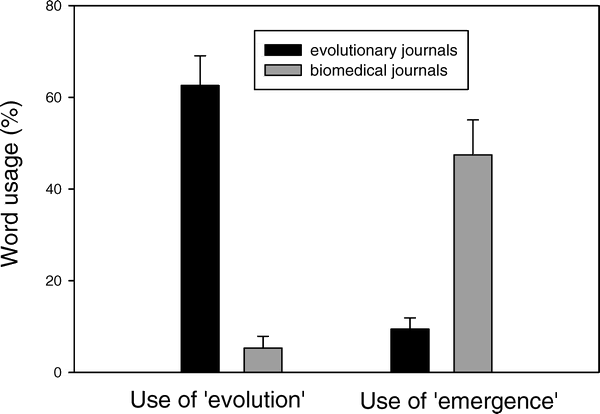 The results, in their words:
The results of our survey showed a huge disparity in word use between the evolutionary biology and biomedical research literature In research reports in journals with primarily evolutionary or genetic content, the word “evolution” was used 65.8% of the time to describe evolutionary processes (range 10%–94%, mode 50%–60%, from a total of 632 phrases referring to evolution). However, in research reports in the biomedical literature, the word “evolution” was used only 2.7% of the time (range 0%–75%, mode 0%–10%, from a total of 292 phrases referring to evolution), a highly significant difference (chi-square, p <0.001).
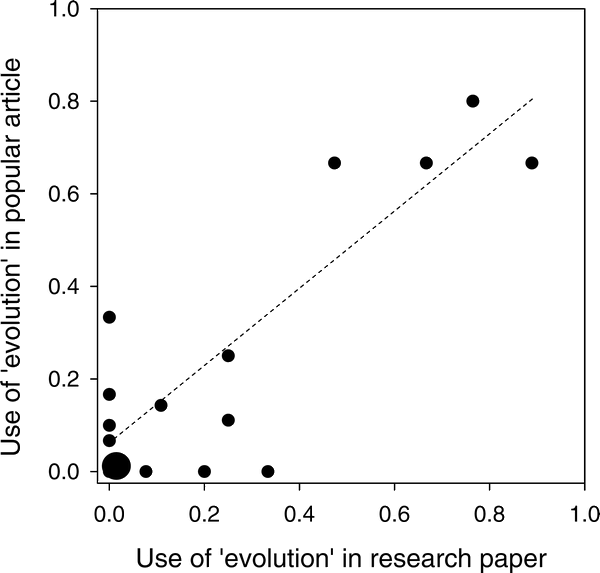 What does it matter, you ask, what terms the scientists use, as long as they understand the process? To find out, the authors did yet another literature search with the E-word--this time in the popular press. They searched for articles about antibiotic resistance in The New York Times, The Washington Post, Fox News, and the BBC. Then they checked to see if a correlation existed between the number of times the word “evolution” was used in a popular article and the number of times it was used in the original scientific paper that the news report was based upon. And guess what? There was a HIGH correlation (graph at left). As the authors put it:
This clearly shows that the public is more likely to be exposed to the idea of evolution and its real-world consequences if the word “evolution” is also being used in the technical literature.
So bottom line, the E-word is likely to get even dirtier if scientists (or doctors, anyway) skirt around its meaning even within a scientific article. Here's a scarier question: Why does the disparity exist between biology and medical journals? Are doctors actually less likely to "believe" in evolution?! Yikes.



11 comments:
Of course, it also means that when doctors say they don't "believe" in evolution, they may simply mean they don't understand their own jargon.
But they use evolution all the time.
Chatgris Press, a premier publisher of titles for which little literature often exists, has published the first and one of the only books on scientific and scholarly journal setup and management. The Peer-Reviewed Journal—A Comprehensive Guide through the Editorial Process is used in more than 14 countries and details processes and procedures for establishing and managing the editorial office of specialty peer-reviewed publications. Structured for editors-in-chief and managing editors, The Peer-Reviewed Journal includes 68 valuable forms, letters, and fax templates, which are included on compact disc in both MS Word and WordPerfect formats for easy modification for your specific needs. To see reviews and a list of buyers, access www.ChatgrisPress.com, Books.
the diet solution program -
the guru assassin -
the power pause -
tmj help -
tonsil stones remedies -
turbulence training -
two minute profits -
vincedelmontefitness -
vince del monte fitness -
warp speed fat loss -
web traffic machines -
wedding speech 4u -
wind plans -
xp repair pro -
your fun business -
zygor guides -
500 love making tips -
acid alkaline diet -
acne no more -
advanced defrag -
anti spyware bot -
art of approaching -
banish tinnitus -
beat eczema -
blood pressure normalized -
burnthefat -
burn the fat -
conversationalhypnosis -
conversational hypnosis -
cpa arbitrage -
creative date ideas -
debt free in three -
digital background -
dirty talking guide -
anti spyware -
anti spyware bot -
article rewriter -
art of approaching -
auto cash system -
burnthefat -
burn the fat -
bv cures -
calling men -
camera dollars -
carb rotation diet -
cash making power sites -
cb mall -
combat the fat -
conversationalhypnosis -
conversational hypnosis -
credit secrets bible -
destroy hemorrhoids -
dirty talking guide -
dotcom income secrets -
duplicate file cleaner -
dvd copy pro -
earth4energy -
earth 4 energy -
easy launcher -
easy system cleaner -
eatstopeat -
eat stop eat -
eczema free forever -
end your tinnitus -
error nuker -
fatburningfurnace -
fat burning furnace -
fat loss 4 idiots -
The Affiliate Code -
The Diet Solution Program -
Truth About Abs -
Zygor Guides -
forex killer -
forex megadroid -
get rid of your cellulite -
g money pro -
google shadow -
governmentregistry -
government registry -
gov resources -
health biz in a box -
homemadeenergy -
home made energy -
hybrid water power -
i software tv -
joyful tomato -
keyword spy pro -
kingdom of pets -
macro virus -
malware bot -
maternityacupressure -
maternity acupressure -
meet your sweet -
microcap millionaires -
moles warts removal -
mole wart removal -
muscle gaining secrets -
natural cure for yeast infection -
paid surveys etc -
panic away -
pdf creator -
public records pro -
ithxbneey http://crush-the-castle.com Crush The Castle
amateur cumshots
me and my asian
asian gfs
cute asians
asian girlfriends
sexy asian gfs
teen asian gfs
asian amateur
amateur asian gfs
asian kinky gfs
hot asian girlfriends
my alternative gf
my suicide gf
emo gfs
punk gfs
alt gfs
indie gfs
emo girlfriends
alternative gfs
amateur emo
dirty emo gfs
my gf loves anal
anal gfs
anal girlfriends
amateur anal
homamade anal
tight anal
hot anal
sexy anal
anime gfs
anime girls
anime girlfriends
wild anime gfs
black teen girlfriends
black gfs
young black gfs
cute black gfs
daddys little gfs
teen gfs
young gfs
little gfs
real emo girlfriends
emo gfs
emo girlfriends
alt gfs
real teenie gfs
teenie gfs
teen gfs
horny teen gfs
really wasted gfs
wasted gfs
durnk gfs
trashed gfs
stick gfs
gfs cumshots
gfs blowjobs
amateur gfs
young asian gfs
asian gfs
wild asian gfs
teen asian gfs
Bondage Hentai
Gay Hentai
Ladyboy Hentai
Tit Anime
Device Bondage
Divine Bitches
Everything Butt
Fucking Machines
Hogtied
Kink Live
Men In Pain
Naked Kombat
Pissing
Sex And Submission
The Training Of O
The Upper Floor
Ts Seduction
Water Bondage
Whipped Ass Blog
Wired Pussy
black gfs
black teen girlfriends
anime girlfriends
anime girls
Alex Devine
Alex Del Monaco
Alex Dane
Alektra Blue
Alejandra Maderos
Alayah Sashu
Alaura Eden
Aimee Tyler
Aimee Sweet
Aiden Starr
Agatha Meireilles
Agatha Cristine
Afrodite Night
Adrienne Klass
Adrienna Anelise
Adrianna Nicole
Adrianna Demarco
Adriana Wild
Adriana Sage
Adriana Russo
Adriana Faust
Adriana Esteve
Adriana Deville
Adriana Davis
Adriana Amante
Adina Jewel
It is important for science communication that accurate terminology like evolution be used consistently across all fields.
Post a Comment