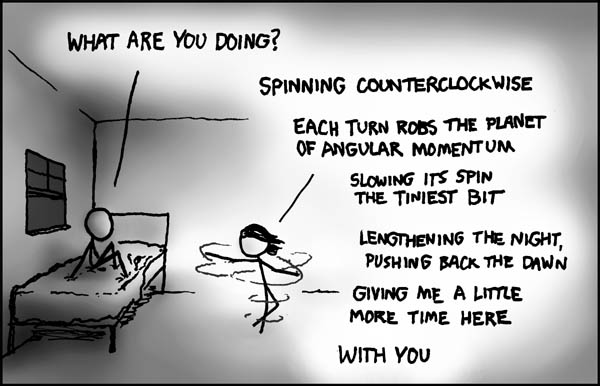
...More hilarious webcomics at xkcd
 The New York Times reports today that NYC's board of health has decided to ban trans fats from each and every restaurant in the city--including McDonald's. Trans fats, which are derived from partially hydrogenated oils and are found in just about every kind of junk food from doughnuts to french fries, have been shown to increase the risk of heart disease.
“...human life is much more important than shelf life,” she said. “I would expect to see fewer people showing up in the emergency room with heart attacks if this policy is enacted.”
 Mark the day, October 18, 2006: Ginny’s going to meet Richard Dawkins! (err, listen to him give a public lecture.) As I’ve said many times on this blog, I love the man and his clever, lucid writing. If you’re in the market for a good read, pick up his new book, The God Delusion, which is now ranked #9 on amazon.com’s bestseller list.
 | American Cities That Best Fit You:: |
| 70% Chicago |
| 65% New York City |
| 65% Philadelphia |
| 60% Boston |
| 60% Washington, DC |
 I just spent the last few days in a breathtakingly beautiful Chicago for the Pale Blue Dot III astrobiology conference. I met some brilliant astrobiologists and astrobiology graduate students, who manage to stay motivated and enthusiastic despite NASA’s significant cuts in the field. And they taught me SO much—about the Earth’s climate, the clouds of Venus, the rocks of Mars, the machines that can determine a distant planet’s surface chemistry by looking at just a speck of light, even the odds of getting hit by an asteroid.
  I just got my hands on Richard Dawkins’s new book, The God Delusion. As my students from last year can attest, I’m a Dawkins fanatic, and am deeply engrossed in his new tome. Not sure if Dawkins is just less cautious now in his elder years, but this book certainly has a tone more...hostile than the others. Pretty amusing so far, though.
Anyway, I found one of the book’s early passages—a quote from Einstein—quite surprising. Dawkins reminds us of Einstein’s most quoted remarks about the existence of God (like “Science without religion is lame, religion without science is blind"), and then hits us with this rarely-quoted doozie from Al:
“It was, of course, a lie what you read about my religious convictions, a lie which is being systematically repeated. I do not believe in a personal God any I have never denied this but have expressed it clearly. If something is in me which can be called religious then it is the unbounded admiration for the structure of the world so far as our science can reveal it.”
...So much for “God doesn’t play dice with the universe,” right?
 I started my new internship at Seed on Tuesday, and got my first Seed clip at 5:27 p.m. today. Habitable worlds, according to a paper that will be released in tomorrow's Science, might just be spinning in solar systems we already knew about, and more exciting--they're probably covered in global oceans.
 Since Wikipedia has so quickly become ingrained in our American culture (with recent feature articles about its creation and evolution in Nature, the New Yorker and the Atlantic), one would think that the list of the 100 most popular Wikipedia pages would reflect those topics that are most important to us. Here's a sampling...
 Once upon a time there was a this, then there was a that, and finally, the end. In today’s Western world, this is how most stories are told. Children’s fables, blockbuster action movies, and even pop songs follow a linear, predictable chronology. And the everyday physical surroundings in our flat, paced, rated, labeled, bounded world are equally predictable. City planners arrange streets in rectangular grids; stoplights turn on, off, on, at timed intervals, to tame the flow of traffic; taxis charge by the mile; buildings are labeled with numbers, and jut from their foundations at 90-degree angles.
James Rouvelle, an artist and technology specialist at the Maryland Institute College of Art, says this metered world affects the way we live, manipulates us, in fact, to behave in a predictable way. “We are wired to scan our environment and adapt to whatever we discover,” he explains, “in other words, we train to the medium.” So we navigate those orderly streets, stop and go when we’re supposed to, wear watches on our wrists. “Our time is monochromic,” he says, “everything is ordered and dictated by a watch.”
Once upon a time there was a this, then there was a that, and finally, the end. In today’s Western world, this is how most stories are told. Children’s fables, blockbuster action movies, and even pop songs follow a linear, predictable chronology. And the everyday physical surroundings in our flat, paced, rated, labeled, bounded world are equally predictable. City planners arrange streets in rectangular grids; stoplights turn on, off, on, at timed intervals, to tame the flow of traffic; taxis charge by the mile; buildings are labeled with numbers, and jut from their foundations at 90-degree angles.
James Rouvelle, an artist and technology specialist at the Maryland Institute College of Art, says this metered world affects the way we live, manipulates us, in fact, to behave in a predictable way. “We are wired to scan our environment and adapt to whatever we discover,” he explains, “in other words, we train to the medium.” So we navigate those orderly streets, stop and go when we’re supposed to, wear watches on our wrists. “Our time is monochromic,” he says, “everything is ordered and dictated by a watch.” And for Rouvelle, this metered sense of time is worrisome. “My concern,” he says, “is that we—Western culture—have, over the past few hundred years, chosen to develop along a trajectory of reductionism, trying to understand things by breaking them down into individuated, component parts whose behaviors are often described as relating to other unique components sequentially, and verified metrically – and often visualized.”
The visual description of time, at least in Western classical art, is often a sequential one. In many of the great Piero Della Francesca's pieces (like The Queen of Sheba's Visit to Jerusalem, above), for instance, the progression of the action is achieved by the viewer looking from left to right. First, then, finally—story told.
But many contemporary artists and architects are looking to break free of this metered perception of time. Rouvelle encourages this change, as he believes an un-metered temporal perspective can enhance both our aesthetic and social experiences. “There are complementary experiences, non-linear experiences,” he says, “where time, for example, is not moving in a specific direction, yet change is evident. I believe that these non-sequential experiences are equally real, however, and that if I could contemplate them more fully my experience overall would be significantly different.” And artists, he says, have the means to create less metered descriptions of the world, and thus make the world a better place. “I believe that if we could improve our understanding of our experience through better and more accurate models,” he argues, “we would experience greater empathy with others.”
Here are a few examples of recent art and architecture that flaunt a non-linear expression of time, and in this way, force their audiences to experience time un-metered…
The Site of Reversible Destiny
 On the other side of the world, in
If you look at a map of the park, the names of the featured sites sound like some kind of metaphysical
The park also—like Disney’s rollercoasters—disturbs balance; a warning on their homepage, written in red text, reads: “Because the Site of Reversible Destiny-Yoro Park has many steep slopes, we advise that you wear rubber-heeled shoes.” Indeed, since the park opened in 1995, Rouvelle says it has had to set aside funding specifically for medical bills of the dozens of visitors who, just from walking around the disorienting landscape, have fractured or broken bones.
Clearly then, the Site of Reversible Destiny creates an endlessness that we don’t normally experience. Psychologist and art critic Rudolf Arnheim argues that this endlessness, especially when experienced outdoors, grants art and architecture “a high aesthetic value.”
Rouvelle would agree. He says the Site of Reversible Destiny—without flat surfaces, street grids, or 90-degree angles—“forces us to come to terms with physical angles that are becoming less and less common” in Western city life; in other words, it’s exactly the kind of art that can help us break free of a metered sense of time.
Expérience de la Durée, Biennale de Lyon 2005
“Experiencing Duration” was the theme of the 2005
Echoing the words of James Rouvelle, Bourriaud and Sans explained on the exhibition’s website why time is such a provocative theme to explore in art: “Addressing time was a way for us to draw up an inventory of the 1990s, when art began to function as a sort of editing bay on which artists could reconstruct everyday reality.” These artists, the curators explained, “tweaked the tempo” of their art—displaying videos and sounds that had been paused, looped, or synchronized in unexpected ways. “Time is more a building material than a mere medium,” Bourriaud and Sans argued. More than a static oil painting or stone monument, they wrote, “art is first and foremost an event.”
Both the Site of Reversible Destiny and the exhibits at the Lyon Biennial use art to manipulate the viewer’s experience of time. But other forms of contemporary art—like interactive sound projects—are themselves manipulated by time. One such dynamic project, designed by Rouvelle and Berlin-based artists Innes Yates and Judith Bieseler, is called Research, Instructions, Programs, and Logic for Trans-Robotic Adaptive Networked Environments, or RIPLTRANE. Launched in March 2004 and still going today, RIPLTRANE allows participants in both
Remove Your Watches!
Changing our experience of time—that is, un-metering it—is not an easy task. It may be worth the psychological (and in the case of the Site of Reversible Destiny, physical) effort for an artist who wants to create and appreciate art in new ways. “Artists can definitely contribute to the creation of better models [of time],” Rouvelle says. “The content of our models and their presence in our common spaces is an aspect of our collective development. We must, I think, take the role of objects and their affect seriously as we build our world.”
But even those uninterested in art, Rouvelle continues, should make the attempt. Experiencing un-metered time, he says, will help our interpersonal relationships, help us to better empathize with others. He argues that, “the general public can benefit by having aspects of their lives made more available for their own consideration via aesthetic creations that explore the complementary senses and experiences of non-linearity.”
To Rouvelle, all of human development, in fact, is about the way we choose to perceive and influence time. “If we want to develop along a different trajectory we must take action and do so. We have a responsibility to do so.”
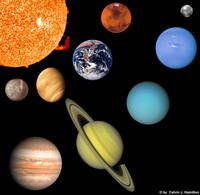 Next week in Prague, a group of astronomers are planning to tell the
International Astronomical Union--the body that decides, officially,
what is or is not a planet--that there are not nine planets, but 12.
Next week in Prague, a group of astronomers are planning to tell the
International Astronomical Union--the body that decides, officially,
what is or is not a planet--that there are not nine planets, but 12. Seems like every product in the CVS aisle is trying to jump on the nanotechnology bandwagon. And thanks to a website created by the nonprofit group Project on Emerging Nanotechnologies earlier this year, anyone with a computer can browse the 200+ nano-products now commercially available. (The list includes, among the somewhat mundane face creams and household cleaners, the more surprising odor-eating shoe inserts, foam neck-support pillows, and even chocolate-flavored bubble gum.)
 In 2003, medical advisors at the FDA declared that Plan B--Barr Pharmaceuticals' morning after pill--was safe and effective enough to sell over the counter, to women of any age.
  A study released last week reveals that many kinds of bacteria sometimes grow minuscule protein-and-iron wires that conduct electricity. The researchers say the wired microbes "will give us insights into all of microbiology that we can't even dream of yet," potentially allowing us to build more-efficient biological fuel cells and understand an important dynamic in the life of bacteria.